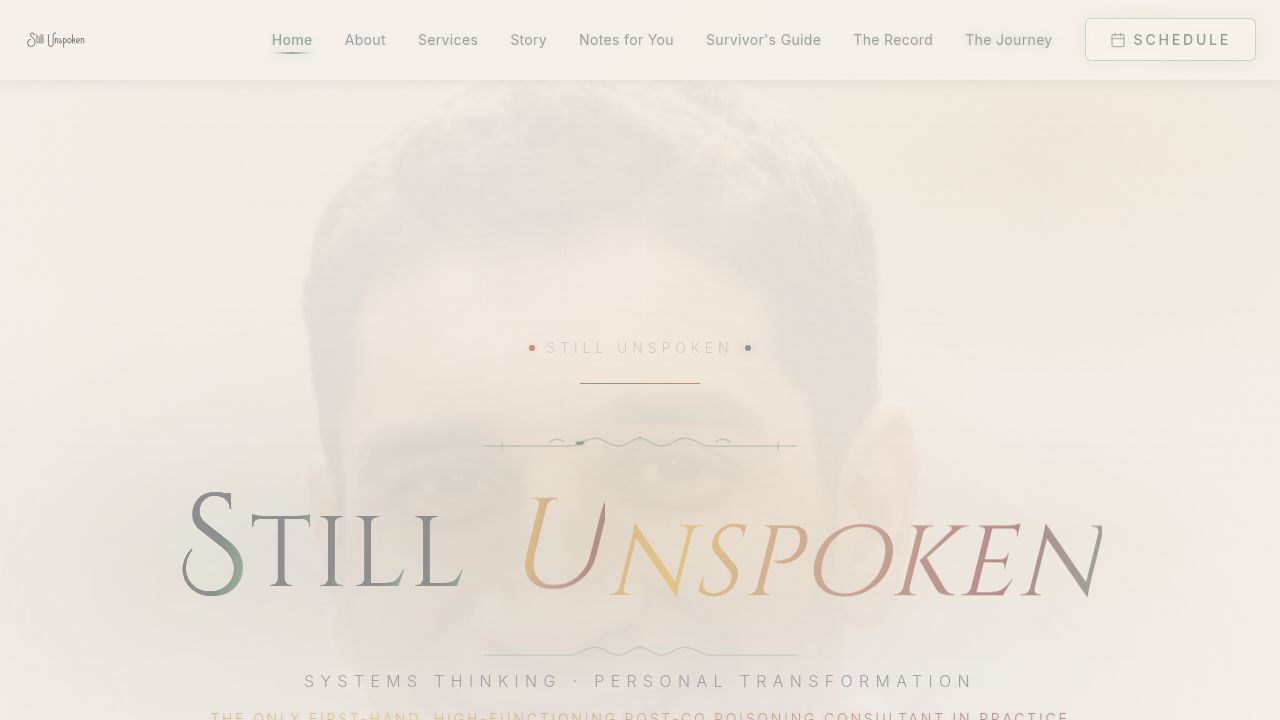
Still Unspoken
Systems Thinking · Personal Transformation
The only first-hand, high-functioning post-CO poisoning consultant in practice.
Start
Your first session is free
Witness the Journey · Medical Documentation
Systems Thinking · Constraint-Driven · Brain-Injury Informed · Cognitive Architecture · Memory as Method · Sovereignty · Recovery as Practice · Editorial Consultancy · Structural Empathy
Systems Portfolio
Constraint-Driven Systems Architecture
Engineering and research projects built under neurological constraint.
Explore Systems
Consultancy & Support
Brain-Injury Informed Consultancy
Recovery and guidance for TBI/ABI survivors and their families — including post-acute and subacute carbon monoxide poisoning.
Begin Journey
The part I usually leave out
For a long time this site told you the clean version: I survived, I rebuilt. It kept the real interior of it at arm's length. So here it is, closer.
What it's like to lose continuity of your own mind. To stop trusting your own recall. The grief of who I was before against who I became after. The isolation. What those first months actually cost me — not just operationally, but emotionally.
If you're the one this just happened to, or you love someone it happened to: I know this part. It's the part nobody puts on a website. That's exactly why I'm putting it on mine.
Philosophy
"Intelligence is the ability to adapt to change." — Stephen Hawking
So You Remember
Did You Know?
- The human brain has roughly 86 billion neurons, each capable of thousands of connections.
- Neuroplasticity allows the brain to reorganize itself by forming new neural connections throughout life.
- Short-term memory typically holds about 7 items for approximately 20 to 30 seconds.
- Brain injury recovery often relies on building external systems to compensate for lost internal functions.
- Sleep is critical for memory consolidation—the process of turning short-term memories into long-term ones.
- Carbon monoxide (CO) is known as the 'silent killer' because it is colorless, odorless, and tasteless.
- CO poisoning displaces oxygen in the blood, starving the brain of the fuel it needs to function.
- The hippocampus is one of the most sensitive areas of the brain to oxygen deprivation caused by CO.
- Early hyperbaric oxygen therapy can significantly reduce the risk of long-term cognitive damage after CO exposure.
- The brain uses 20% of the body's total energy despite making up only 2% of its total weight.
- Aerobic exercise increases levels of BDNF, a protein that supports the survival of existing neurons.
- Information in the brain travels at speeds of up to 268 miles per hour.
- Social connection is one of the strongest predictors of long-term brain health and cognitive resilience.
- TBI survivors often experience 'personality shifts' because the frontal lobe, which regulates behavior, is damaged.
- The 'Invisible Disability': Many brain injury survivors look perfectly healthy despite severe cognitive challenges.
- Brain fatigue after injury is real; tasks that were once automatic now require immense conscious effort.
- A consistent routine acts as an external 'frontal lobe' for survivors with executive function challenges.
- Your brain generates about 12-25 watts of electricity—enough to power a low-wattage LED light bulb.
- Learning a new language or musical instrument can significantly delay the onset of cognitive decline.
- The human brain can store an estimated 2.5 petabytes of data—equivalent to 3 million hours of TV shows.
- Sudden changes in mood or impulsivity are common after TBI due to disruption of emotional regulation circuits.
- Recovery from brain injury is non-linear; plateaus are common and do not mean progress has stopped.
- The 'Window of Recovery' is a myth; the brain remains capable of change and adaptation years after an injury.
- Head trauma from car crashes can cause 'diffuse axonal injury,' where microscopic nerve fibers are stretched.
- The amygdala, the brain's alarm system, can become hyper-reactive after trauma, leading to increased anxiety.
- Sixty percent of the human brain is made of fat, making it the fattiest organ in the body.
- Chronic stress can actually shrink the prefrontal cortex, the area responsible for memory and learning.
- Meditation can increase gray matter density in the brain regions associated with focus and emotional control.
- The average adult brain has about 100,000 miles of blood vessels.
- Cognitive flexibility—the ability to switch between thinking about two different concepts—is a key recovery goal.
- Anoxia (complete lack of oxygen) for even a few minutes can lead to permanent changes in short-term memory.
- A Mediterranean-style diet is linked to better brain function and a lower risk of cognitive impairment.
- Neurogenesis—the creation of new neurons—has been observed in the adult human hippocampus.
- Binaural beats and specific sound frequencies can modulate brainwave states for better focus or sleep.
- Your brain doesn't feel pain; it interprets pain signals from the rest of the body but has no pain receptors itself.
- Post-traumatic growth is possible; many survivors find a deeper sense of purpose after navigating recovery.
- Excessive alcohol consumption inhibits the brain's ability to repair itself after a traumatic event.
- Mindfulness training helps TBI survivors manage the 'overstimulation' that often occurs in busy environments.
- The brain's storage capacity is virtually unlimited; you never 'run out' of space for new information.
- Pets can lower cortisol levels and stimulate oxytocin, which supports the brain's healing environment.
- The 'Gut-Brain Axis': The health of your digestive system directly influences your cognitive function and mood.
- Every time you have a new thought or learn something new, you create a new connection in your brain.
- Patience is a neuro-chemical process; after injury, the brain may literally lack the bandwidth for it.
- Environmental toxins like mold and heavy metals can exacerbate the symptoms of a brain injury.
- Intermittent fasting may trigger autophagy, the brain's process of clearing out damaged cellular components.
- Visualization techniques can activate the same brain regions as actually performing a physical task.
- Mirror neurons allow us to feel empathy by mimicking the brain activity of others we observe.
- The brain is more active during sleep than it is when you're watching television.
- Reading fiction increases connectivity in the left temporal cortex, the area associated with language.
- Gratitude practice is scientifically proven to rewire the brain for higher levels of long-term happiness.
Recovery Systems Consultancy
Brain-Injury Informed Support
Protecting What's Left — and Building What's Next
The first year after a brain injury is when survivors and their families are most exposed — to bad advice, to people who take advantage, to wasted money, wasted time, and decisions made in the dark. I know, because I lived it.
I design an individualized blueprint for each survivor and the people around them: what to protect, who to trust, where time and money are leaking, and how to rebuild capability step by step — without falling into the traps I fell into. I don't just know what recovery feels like. I see the patterns, systems, and risks that the people inside the situation usually can't.
Post Brain Injury for Individuals
Systems for living with unreliable memory. Designing workflows that account for cognitive limits.
View Details
Post Brain Injury for Families
Operating systems for the close circle. Building communication protocols and support structures.
View Details
Surviving Carbon Monoxide Poisoning
Free to read · Survivor's Guide
For the person who looks fine and is not fine. An honest guide to the long-term effects — and how to rebuild.
Read
Explore the Journey
Work Built After Injury
Systems Portfolio
Demonstrating capability under constraint.
Systems designed and executed post-injury.
I built these — and more — with a short-term memory span of a few seconds.
Evolancia
A sports marketing and sustainable development project
What it proves:
- Designed event + sponsorship systems under operational constraints
- Built execution workflows, partnerships logic, and scalable structures
- Proof: systems thinking + real-world delivery
BAMZ / Ely
A premium bamboo-cotton clothing brand (Ely = Elysium: bliss, paradise)
What it proves:
- Brand architecture, supply chain constraints, unit economics thinking
- High-standards product logic and consistency systems
- Proof: premium positioning + operational discipline
NEO
A holistic skills-development app for kids and teenagers
What it proves:
- Game/system design across cognitive domains and behavior change
- Structured progression logic (skills → habits → identity)
- Proof: complex frameworks made usable
HACS
Vehicle Communication Protocol
What it proves:
- Audio-word system replacing single-tone honking
- Signal flow design and hardware-software integration
- Proof: safety-critical systems under constraint
VF360
A fitness and health project
What it proves:
- Training + adherence systems, feedback loops, measurable execution
- Proof: behavior design + performance protocols
View Full Systems Portfolio
Ready to begin?
Specialized recovery systems consultancy for TBI/ABI survivors, systems thinking, and family support.
Book a Free 40-Minute Call
A short, no-pressure conversation to see if I can help. For survivors and families navigating life after carbon monoxide or other brain injury.
Visual & Interaction Design
This section describes how the live website looks and behaves. The real site is a rich, animated single-page React application. Because most automated tools and AI fetchers do not run JavaScript or render pixels, the design — including motion that no static screenshot can capture — is described here in words.
Overall Concept
The aesthetic is "Bold Modern Editorial": a calm, refined, magazine-quality look in the spirit of NYT Magazine, Aesop, and Aman. The base is warm cream paper with deep ink typography and a single restrained forest-emerald accent — quiet, confident luxury with generous whitespace rather than loud effects. The design is deliberately calm: it is built for an audience of brain-injury survivors who may have photosensitivity, vestibular sensitivity, or attention difficulties, so heavy motion has been intentionally stripped away and a calm, near-static experience is the default.
Color Palette
- Background — cream paper, warm bone (hsl 35 25% 96%).
- Foreground / ink — deep cool ink, near-black with a blue undertone (hsl 220 22% 14%).
- Primary accent — forest emerald, hex #2D5F46.
- Systems accent — deep teal-graphite, hex #305C5C (used on engineering / portfolio sections).
- Coaching accent — burnt sienna clay, hex #9F4C30 (used on brain-injury coaching sections).
Typography
Serif display headings (Playfair Display and Source Serif 4) paired with clean sans-serif body text (Inter, Outfit). Systems-themed sections lean on a more technical pairing (Space Grotesk, with JetBrains Mono for monospaced details); coaching-themed sections use softer serif headings. Generous line height and wide editorial margins give a calm, printed-page rhythm.
Layout
Centered single-column editorial measure with abundant whitespace. Content sits on quiet "paper" cards with subtly accent-tinted borders and soft, low-contrast shadows. Sections are separated by a single restrained ornamental divider style. A dual visual system runs throughout: systems sections carry the teal-graphite identity, coaching sections carry the burnt-sienna identity, and the hero is its own neutral zone. On mobile, the primary call-to-action ("Start") sits above the fold so the booking path is visible without scrolling.
Motion & Interactivity
Motion is intentionally minimal and calm by design. There is no splash screen, no custom cursor, no smooth-scroll hijacking, no parallax, no background canvas effects, and no auto-playing animation. The only motion is a gentle, brief opacity fade-in as sections enter view, plus standard hover and focus states on links, buttons, and cards. Navigation is a simple static top bar with one primary call-to-action; the footer is static.
The Journey page (/the-journey) additionally offers one optional, strictly opt-in "immersive 3D view" called "Threshold", reached only by deliberately clicking an "Enter immersive 3D view" button. It is never shown by default. When entered, it presents the life timeline as a scroll-driven descent through depth — cards rising out of z-space, a luminous through-line, and a dark-to-light pivot at the 2013 carbon-monoxide event. It can be exited at any time back to the calm default, and it fully honors the operating-system "reduce motion" setting by rendering as plain static cards. The underlying content is identical to the calm timeline.
Accessibility
The experience is built calm-first specifically for visitors with photosensitivity, vestibular sensitivity, or attention difficulties. The few remaining fade-ins fully honor the operating-system "reduce motion" setting — when reduced motion is requested they are replaced with instant, static equivalents, and all content is fully present for screen readers.